
Integrated Peer Review Proccess
INCOFIMS & INCOBIFS 2025 × Partner Journals
🎯 Purpose
To ensure a transparent, ethical, and efficient scholarly publication pipeline, the peer-review process for INCOFIMS and INCOBIFS 2025 is fully delegated to partner journals. The organizing committee does not engage in any peer review or editorial decision-making after nominating manuscripts. This model adheres strictly to COPE standards and provides maximum editorial autonomy to the journals, including freedom to determine review models, licensing, publication timelines, and formats. It aims to:
- Clearly delineate the responsibilities of each stakeholder: the Conference Committee, Authors, and Journal Editors.
- Ensure that the full peer-review process is managed entirely by the journals, not by the conference or any conference-based OJS system.
- Uphold publication ethics in accordance with COPE standards while allowing each journal to maintain autonomy over licensing, review policies, and editorial timelines.
✅ Roles & Core Tasks
Roles and Responsibilities
The Conference Committee acts as the first-level screener. Their primary task is to receive abstracts and full manuscripts, check their alignment with the scope and aims of the conference, and perform plagiarism screening using Turnitin. They identify and nominate approximately 20–30 manuscripts with strong potential for international publication. Importantly, after the nomination stage, the committee's role ends—the journal’s editorial team takes over the entire peer-review and publication process.
The Authors are responsible for submitting abstracts and full papers to the conference, and later uploading nominated articles to the designated journal’s Open Journal System (OJS). Authors must comply with each journal’s formatting guidelines, revise manuscripts based on reviewer feedback, submit required documents (e.g., cover letters, author declarations), and confirm the final proof before publication. Authors communicate directly with the journal, not the conference committee, once the journal submission phase begins.
The Journal Editors and Reviewers have full editorial authority. They define the peer review system—whether double-blind, single-blind, or open review—and appoint at least two independent international reviewers. Editors oversee all editorial decisions: acceptance, revision, or rejection. Furthermore, journals determine whether articles will appear in special issues or regular issues, and manage the final steps of publication including assigning DOIs and applying licensing terms (e.g., CC BY or CC BY-SA). The conference does not interfere in any of these processes.
Stakeholder Responsibilities
| Conference Committee | • Accept and screen submitted abstracts • Conduct a preliminary evaluation of abstracts and full manuscripts submitted to the conference via the OJS platform. This includes checking whether the topic aligns with the scope of the conference and assessing the basic academic quality—such as clarity of objectives, relevance of the content, and general structure—before recommending the manuscript for submission to a partner journal. • Run a plagiarism check using Turnitin • Nominate 20–30 manuscripts for submission to designated partner journals • Set broad important dates (such as abstract deadlines) • Do not participate in the peer-review, evaluation, or editorial decisions once a manuscript has been submitted to the journal |
|---|---|
| Author | • Submit abstracts and full papers to the conference committee • Upload selected manuscripts to the appropriate journal’s OJS system • Respond to reviewer and editor comments • Complete and submit any required journal documentation (cover letter, author declaration, licensing forms) • Approve the final galley proof before publication |
| Journal (Editors & Reviewers) | • Determine the type of peer review to implement (Double-Blind, Single-Blind, or Open Review) • Appoint a minimum of two independent international reviewers per manuscript • Oversee the complete peer-review and editorial process via the journal's OJS platform • Make all editorial decisions (Accept, Minor/Major Revision, Revise & Resubmit, Reject) • Set their own review schedules and editorial timelines • Decide on the publication model (Special Issue or Regular Issue) • Publish manuscripts with DOI and assign licensing as per their policy (e.g., CC BY, CC BY-SA) |
🔄 Integrated Workflow Overview
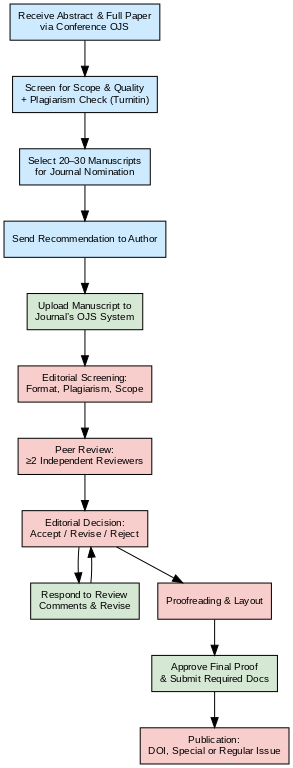
Once an abstract is submitted to the conference, the paper undergoes a scientific screening. If eligible, authors are invited to upload the full article to the selected partner journal. The journal then initiates its standard editorial process: initial screening, plagiarism check, formatting compliance, peer review, editorial decisions, and revisions. Authors may receive one of several editorial outcomes—acceptance, minor or major revisions, revise-and-resubmit, or rejection. Once accepted, the manuscript proceeds to copyediting, proofreading, and layout prior to publication. Journals decide the publishing model, which may include issue-in-press, issue-in-progress, Special issue, regular issue, or fully published articles with DOI.
- Abstract Submission → Initial screening for topic relevance and academic merit by the Conference Committee
- Full Paper Submission → Assessed for scope alignment and plagiarism by the Conference Committee
- Nomination Notification → Authors receive instructions to submit their full article to the selected partner journal’s OJS
- Journal Submission (OJS) → Manuscript uploaded by author to the journal system
- Editorial Screening → Basic checks for formatting, plagiarism, and scope compliance by the journal editor
- Peer Review → Conducted entirely by the journal, with at least two qualified reviewers
- Editorial Decision → Includes Accept, Minor/Major Revision, Revise & Resubmit, or Reject
- Revisions → Authors revise and resubmit as requested by the journal
- Final Layout & Proofing → Managed by the journal team, including copyediting and galley production
- Publication → Journal decides when and how the article is published (In-Press, In-Progress, Final Issue) with DOI
🗂 Editorial Decision Glossary
| Code | Description | Journal Action |
|---|---|---|
| Accept | Publish in current form | Proceed to final layout and proofing |
| Minor Revision | Minor adjustments needed | Author follows journal’s deadline for revision |
| Major Revision | Substantial changes required | Re-review may be required before decision |
| Revise & Resubmit | Not accepted in current form | New round of submission possible after revision |
| Reject | Manuscript not accepted | Author may appeal if allowed by journal policy |
✏️ Revision & Proofing Policy
Key Clarifications
- All deadlines, including revision periods and publication schedules, are set by the journal, not the conference. The conference only establishes “important dates” relevant to abstract submission and recommendations.
- Publication charges (APC), if applicable, are communicated and handled directly between the journal and the authors.
- Each journal has the autonomy to determine whether the submitted manuscripts will be published in a special issue or regular issue.
- The journal reserves the right to accept, reject, or request further revision of any manuscript, based solely on its editorial standards and peer review outcomes.
- Once a manuscript enters the journal’s editorial system, all correspondence, revisions, and decisions fall under the journal’s jurisdiction. The Conference Committee is no longer involved. The journal manages the timeline and ensures quality through professional copyediting and author-approved proofreading, culminating in formal publication.
🔐 Ethics & Copyright Compliance
- Journals are responsible for applying their own peer-review model and publication ethics in line with COPE standards.
- Journals also determine the copyright model and licensing terms (e.g., Creative Commons).
- Authors are responsible for paying any Article Processing Charges (APC) directly to the journal, if applicable.
📊 Transparency and Tracking
- Journals track every stage of the editorial process in their OJS platform.
- The conference website will provide a list of all partner journals, scope alignment information, and detailed submission guidance to authors.
Conclusion: This integrated model ensures that scholarly integrity and transparency are preserved, while giving each partner journal full editorial control. From abstract submission to final publication, the process empowers authors and journals—while the conference plays a facilitating and curating role only.