Integrated Peer Review Proccess
001 Purpose
To ensure a transparent, ethical, and efficient scholarly publication pipeline, the peer-review process for INCOFIMS and INCOBIFS 2025 is fully delegated to partner journals. The organizing committee does not engage in any peer review or editorial decision-making after nominating manuscripts. This model adheres strictly to COPE standards and provides maximum editorial autonomy to the journals, including freedom to determine review models, licensing, publication timelines, and formats. It aims to:
- Clearly delineate the responsibilities of each stakeholder: the Conference Committee, Authors, and Journal Editors.
- Ensure that the full peer-review process is managed entirely by the journals, not by the conference or any conference-based OJS system.
- Uphold publication ethics in accordance with COPE standards while allowing each journal to maintain autonomy over licensing, review policies, and editorial timelines.
002 Roles and Responsibilities
The Conference Committee acts as the first-level screener. Their primary task is to receive abstracts and full manuscripts, check their alignment with the scope and aims of the conference, and perform plagiarism screening using Turnitin. They identify and nominate approximately 20–30 manuscripts with strong potential for international publication. Importantly, after the nomination stage, the committee's role ends—the journal’s editorial team takes over the entire peer-review and publication process. The Authors are responsible for submitting abstracts and full papers to the conference, and later uploading nominated articles to the designated journal’s Open Journal System (OJS). Authors must comply with each journal’s formatting guidelines, revise manuscripts based on reviewer feedback, submit required documents (e.g., cover letters, author declarations), and confirm the final proof before publication. Authors communicate directly with the journal, not the conference committee, once the journal submission phase begins. The Journal Editors and Reviewers have full editorial authority. They define the peer review system—whether double-blind, single-blind, or open review—and appoint at least two independent international reviewers. Editors oversee all editorial decisions: acceptance, revision, or rejection. Furthermore, journals determine whether articles will appear in special issues or regular issues, and manage the final steps of publication including assigning DOIs and applying licensing terms (e.g., CC BY or CC BY-SA). The conference does not interfere in any of these processes.
003 Stakeholder Responsibilities
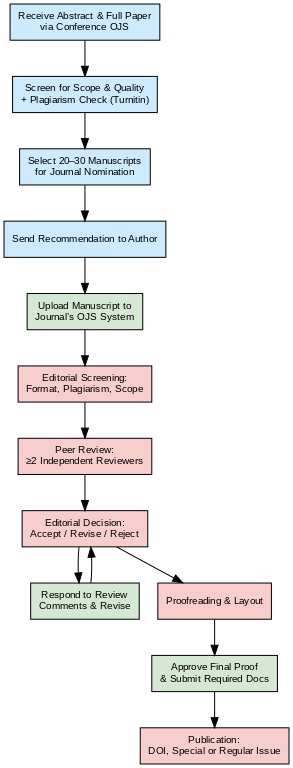
004 Integrated Workflow Overview


005 Revision & Proofing Policy

Conclusion: This integrated model ensures that scholarly integrity and transparency are preserved, while giving each partner journal full editorial control. From abstract submission to final publication, the process empowers authors and journals—while the conference plays a facilitating and curating role only.