
(2025): PROCEEDING OF 8th INTERNATIONAL SYMPOSIUM OF PUBLIC HEALTH (ISOPH)
The Proceedings Journal of the International Symposium on Public Health (ISoPH) 2024, with the theme “Opportunities and Challenges in the Development of AI-Based Public Health,” compiles scientific articles from academics, researchers, practitioners, and students that explore the development of Artificial Intelligence (AI) in addressing opportunities and challenges in the field of public health. This proceeding aims to document scientific contributions in supporting digital transformation at the international level and to provide new insights into the implementation of AI for the advancement of public health.
The published articles cover key topics including technological innovation, the application of AI in various sectors, challenges in AI development, as well as collaboration among stakeholders in creating an inclusive and sustainable digital ecosystem. Through this proceeding, it is expected that the exchange of ideas and knowledge will strengthen national competitiveness and foster the development of AI-based research and innovation in public health.
Community Nutrition
Environmental Health, Occupational Health and Safety
Epidemiology
Health Promotion
Health System, Health Insurance, Health Equity, Health Policy and Administration
Reproductive, Maternal, Child, and Adolescent Health
The International Symposium on Public Health (ISoPH) 2024, held on September 17–18, 2024, with the theme “Opportunities and Challenges in the Development of AI-Based Public Health,” brings together scientific contributions from academics, researchers, practitioners, and students who explore the role of Artificial Intelligence (AI) in addressing opportunities and challenges in public health. This conference aims to serve as a platform for advancing scientific contributions that support digital transformation at the international level and to provide new insights into the implementation of AI for the improvement of public health.
The topics covered in this conference include
- Community Nutrition
- Environmental Health, Occupational Health and Safety
- Epidemiology
- Health Promotion
- Health System, Health Insurance, Health Equity, Health Policy and Administration
- Reproductive, Maternal, Child, and Adolescent Health
Through this conference, it is expected that the exchange of ideas and knowledge will strengthen national competitiveness and encourage the development of research and innovation in AI-based public health.
The International Symposium on Public Health (ISoPH) was established as a response to the growing need for a global forum that addresses complex public health challenges through collaborative research and innovation. Rapid advancements in science and technology, particularly in the field of Artificial Intelligence (AI), have created both opportunities and challenges for the development of public health systems. Recognizing the importance of knowledge exchange among academics, researchers, practitioners, and policymakers, ISoPH was initiated to provide a platform for scientific communication, sharing best practices, and fostering interdisciplinary collaboration.
Dewan Redaksi:
Berdasarkan Keputusan Dekan FKM UNAIR Nomor: 225/UN3.1.10/2023
Executive Committee:
- Prof. Dr. Santi Martini, dr., M.Kes.
- Prof. Dr. Nyoman Anita Damayanti, drg., MS.
- Dr. Muhammad Atoillah Isfandiari, dr., M.Kes.
- Prof. Trias Mahmudiono, S.KM., MPH (Nutr.), GCAS.Ph.D.
Steering Committee:
- Prof. Ririh Yudhastuti, drh., M.Sc.
- Dr. Sri Widati, S.sos., M.Si.
- Dr.Atik Choirul Hidajah, dr., M.Kes.
Organizing Committee:
Ketua Umum : Dr. Hari Basuki Notobroto, dr., M.Kes
Ketua Pelaksana : Bdn. Ni Gusti Ayu Pramita Aswitami, S.SiT., M.Kcb.
Wakil Ketua I : Ika Setyo Rini, S.Kep., Ners., M.Kep.
Wakil Ketua II : Musfirah, S.Si., M.Kes.
Sekretaris I : Septyani Prihaliningsih, S.KM., Μ.Κ.Κ.Κ.
Sekretaris II : Bdn. Sri Wahyuningsih, S.ST., M.Keb.
Bendahara I : Ratna Aricsta Dwi Andriani. SST., MPH.
Bendahara II : Ns. Lantin Sulistvorini, S.Kcp., M.Kes.
Sekretariatan dan Web:
- Nina Dilla MuHikhah, S.Si., M.Sc.
- Jiarti Kusbandiyah, S.SIT., M.Kes
- Retno Twistandayani, S.Kep, Ns, M.Kep.
- Dwi Retnowati, S.Kep., Ns., M.Kes
Sie Acara:
- Christyana Sandra, S.KM., M.Kes.
- Hani Tuasikal, S.Kep., Ns., M.Kep.
- Faisal Amir, S.Kep., Ns., M.Si,
- Selpina Embuai, S.Kep., Ns., M.Kep.
- Tri Nurminingsih Hatala, S.Kep., Ns., M.Kep., M.Kes.
- Raditya Kurniawan Djoar, MS., Ners.
Sie Publikasi, Kerjasama, Desain, dan Dokumentasi:
- Babucarr Jassey, BS.c, M.Epid., Ms.c
- Reny Indrayani, S.KM., M.KKK
- Fitria Dwi Anggraini, SST., M.Kes
Sie Ilmiah dan Jurnal:
- Dwi Faqihatus Syarifah Has, S.KM., M.Epid.
- Siska Nurul Abidah, S.ST., M.Tr.Keb
- Khuliyah Candraning D., S.KM., M.KL.
- M. Rasyid Ridha, S.KM., M.Sc.
- dr. Rukmini, M.Kes
- Tumaji, SKM., MPH.
- Anni Yulianti, S.KM., M.KM
- Moomina Siauta, S.Kep., Ns., M.Kep
Editor
- Dr. Hari Basuki Notobroto, dr., M.Kes
- Prof. Dr. Ririh Yudhastuti, drh., M.Sc.
- Dr. Sri Widati, S.Sos., M.Si.
- Dr. Atik Choirul Hidajah, dr., M.Kes.
- Khuliyah Candraning Diyanah, S.KM., M.KL.
- Endah Kusumawardani
Reviewer
- Dr. Hari Basuki Notobroto, dr., M.Kes
- Prof. Dr. Ririh Yudhastuti, drh., M.Sc.
- Prof. Dr. Santi Martini, dr., M.Kes.
- Dr. Sri Widati, S.Sos., M.Si.
- Dr. M. Bagus Qomaruddin, Drs., M.Sc
- Dr. Shrimarti Roekmini Devy, Dra., M.Kes
- Dr. Atik Choirul Hidajah, dr., M.Kes.
- Prof. Kuntoro, dr., M.PH., Dr.PH
- Prof. Dr. Nyoman Anita Damayanti, drg., M.S.
- Prof. Dr. Ir. Annis Catur Adi, M.Si.
- Prof. Trias Mahmudiono, S.KM., M.PH (Nutrition), G.CAS. Ph.D.
- Dr. Djazuly Chalidyanto, S.KM., M.ARS.
- Dr. Ernawaty, drg., M.Kes.
- Dr. Rr. Soenarnatalina M., Ir., M.Kes
- Dr. Mahmudah, Ir, M.Kes
- Dr. Nunik Puspitasari, SKM., M.Kes
- Khuliyah Candraning Diyanah, S.KM., M.KL.
- Ni Gusti Ayu Pramita Aswitami, S.SiT., M.Keb.
- Christyana Sandra, S.KM., M.Kes.
- Dwi Faqihatus Syarifah Has, S.KM., M.Epid.
- Muhammad Rasyid Ridha, S.KM., M.Sc
- Abdullahi Musa
- Babucarr Jassey
- Dr. Ahmad Khalil Yaqubi
Keynote Speakers
- Budi Gunadi Sadikin
- Adhy Karyono, A.KS., M.AP
Honored guest Speakers
- Prof. Dr. Emily Chia-Yu Su, B.SC., M.SC., Ph.D
- Prof. Ira Nurmala, S.KM., M.PH., Ph.D
- Prof. James R. Warren
- Prof. Masaharu Kagawa BSc(Hons) PhD RPHNutr ISAK
- Dr. Mohd Yusmaidie Aziz
Guidelines for Oral Presentation
- Oral presenters must adhere strictly to the schedule provided by the committee
- Changes to the presentation schedule are not permitted, as the committee has finalized the timetable
- Presentations, Q&A sessions, and discussions must be conducted in English
- Participants must be present on time according to the event schedule
- Participants wear neat, polite clothes and wear shoes
- Register by scanning a barcode
- Presenters should prepare thoroughly, as the Best Oral Presenter will be selected based on the assessment form
- If a presenter is unable to attend as scheduled, they must inform the committee immediately If an alternate presenter is arranged, the committee must also confirm this
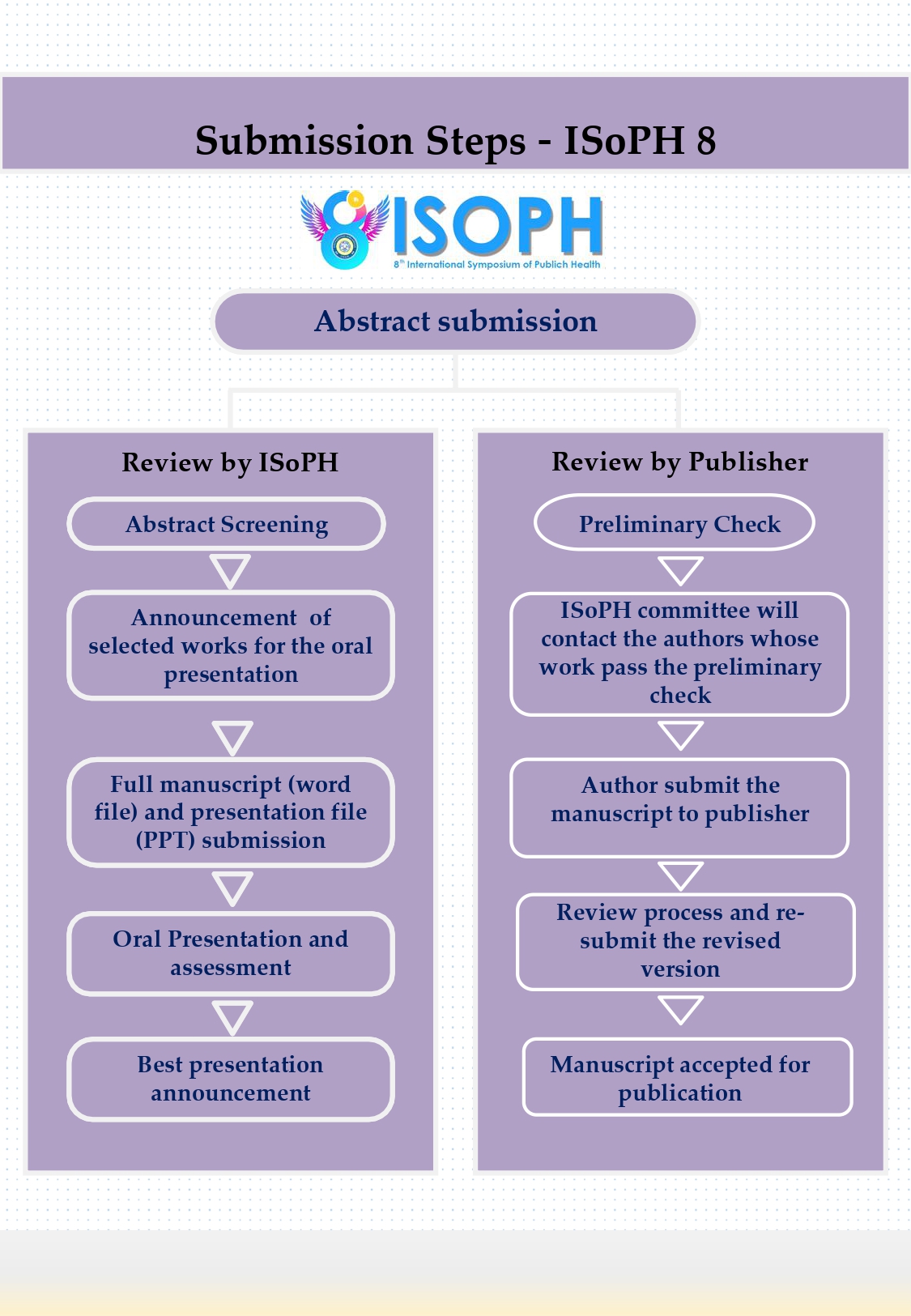
- Topic 8 th International Symposium of Public Health ISoPH
a. Time Sep 17 2024 08 00 Sep 18 2024 08 00
b. Join Zoom Meeting https s id/isoph 8 th (Passcode isoph) - The oral presentations will be conducted over two days
a. Day 1 Tuesday, September 17 2024
b. Day 2 Wednesday, September 18 2024 - Room For Oral Presenter (Offline) : Room 1 : 1rd Floor Ballroom, Room 2 : 3rd Floor Meeting Room (Sulawesi room), and Room 3 : 3rd Floor Meeting Room (Kalimantan room). Room For Oral Presenter (Online) : Room 1 : Breakout Room 1, Room 2 : Breakout Room 2, and Room 3 : Breakout Room 3.
- Presenters are allocated 7 minutes for their presentation (in PowerPoint format), followed by a panel style Q&A session.
- Each room will have two sessions:
a. Session I Before the coffee break
b. Session II After the coffee break - In each session, 2 3 presenters will deliver their presentations, followed by a panel discussion
- Rooms will be organized according to the names of the oral presenters
- Presenters will be evaluated by the moderator (using an assessment form) in collaboration with the assistant moderator to determine the Best ISOPH 8 Presenter
- For participants only, during the oral presentation they can be present in the room according to their respective interests, online participants can attend the breakoutroom and offline participants can attend the ballroom or meeting room
For Online Participant/Presenter
- Online presenter are required to share their screens to present their material
- Presenters must use the official ISOPH 8 background
- Presenters must keep their cameras on and microphones muted when not presenting
- Ensure that your sound is clear, and that your audio quality is sufficient for smooth communication
- Questions can be submitted through the Zoom chat or asked directly during the session
- During the presentation, use PowerPoint or similar tools, and presenters must have their cameras activated while presenting
ABSTRACT (Times News Roman, 12pt, Italic)
Background
It should be statements about background and purposes of study. The body of your abstract begins here. The abstract should be a concise summary of your research article. It should be typed single-spaced in 12 point Times New Roman. Be sure to adhere to the word limitation (250 words), all texts must fit within one A4 page with the following margin settings: Top & Bottom & Right & Left: 1 inch (2.54 cm). The abstract must be written in English, one single paragraph and state the objective of research, short methodology, and research output as well as final conclusion. Abstract document (doc or docx format) should be submitted via online submission through the conference website.
Methods
Describe the research design and settings; Participants/respondents (details of how they selected, inclusion and exclusion criteria, numbers entering and leaving the study, relevant clinical and demographic characteristics), and type of analysis.
Results and Discussions
Report of main outcomes or findings including (where relevant) levels of statistical significance and confidence intervals.
Conclusions
It should relate to study aims and hypotheses and may further research if needed.
Keywords (Font type Times News Roman, size 10pt and number of keywords not more than 5 keywords)
References
References must be listed at the end of the paper by following the APA version 6 format.
Cite references in the text with author name/s and year of publication in parentheses (“APA Writing Style”). For one or two authors, the references should be cited as Egan (2008), (Egan, 2008), William and Lewis (2011) or (William & Lewis, 2011). For three or more authors, include only the surname of the first author followed by et al. and year of publication, e.g. Cheng et al. (2012) or (Cheng et al., 2012). For two or more papers published in the same year by the same author(s), it can be written as Cheng et al. (2012a, b). If two or more authors are cited at the same point in the text, then they are included in the same in-text citation, separated by a semicolon, e.g. (Egan, 2008; William & Lewis, 2011).
Please ensure that every reference cited in the text is also present in the reference list (and vice versa). Maximum number of references is 20. The references should be in alphabetical order. See examples in the list of references below.
Below are examples of entries for journal article, newspaper article, article in electronic journal by DOI (no paginated version), online document, journal article with DOI (and with page numbers), book chapter and book.
1. Journal
Chen, S. J., & Chen, S. M. (2007). Fuzzy risk analysis based on the ranking of generalised trapezoidal fuzzy numbers. Applied Intelligence, 26(1), 1-11.
Kahraman, C., Cevi, S., Ates, N. Y., & Gulbay, M. (2007). Fuzzy multi-criteria evaluation of industrial robotic systems. Computer & Industrial Engineering, 52, 414-433 (2007). doi: 10.1016/j.cie.2007.01.005.
2. Online Document
Chua, D. (2014, April 25). New wave of choreographers. New Straits Times, p.7.
Gomez, M.M., Sierra, J.M.C., Jabaloyes, J., & Zarozo, Manuel. (2010). A multivariate method for analyzing and improving the use of student evaluation of teaching questionnaires: A case study. Quality Quantitative. doi: 10.1007/s11135-010-9345-5.
3. Website
Gunkel, M. (2008). Guidelines for academic writing. http://www.im.ovgu.de/im_media/downloads/examinations/academic_paperwriting_MG.pdf. Accessed 20 Feb 2014.
4. Books
Ramli, N., & Mohamad, D. (2010). On the Jaccard index with a degree of optimism in ranking fuzzy numbers. In E. Hullermeier, R. Kruse, & F. Hoffman (Eds.), Information processing and management of uncertainty in knowledge-based system application (pp. 383-391). New York: Springer.
Rosen, K.H. (1988). Discrete mathematics and its applications. New York: Random House, Inc.
PUBLICATIONETHICS
The proceedings “Opportunities and Challenges in the Development of AI-Based PublicHealth” are scientific proceedings that publish research findings, conceptual studies, andscientificdevelopmentsinthefieldofPublicHealth,particularlythoserelatedtotheapplication and challenges of Artificial Intelligence (AI) in public health. These proceedingsimplementamanuscriptselectionandreviewprocess(peerreview)toensurescientificqualityandacademicintegrity.
This publication ethics statement aims to explain the ethical standards for all parties involvedin the proceedings publication process, including authors, editors, reviewers, the scientificcommittee,and theproceedingspublisher.
PublicationEthicsGuidelines
Theproceedingspublisherbearsfullresponsibilityforallstagesofthepublicationprocessandis committed to maintaining editorial independence. Decisions regarding the acceptance orrejection of manuscripts are not influenced by commercial interests, sponsors, or any otherexternal parties.
ResponsibilitiesoftheEditor
The proceedingseditorisresponsible for:
- Ensuring the scientific quality of manuscripts and their relevance to the theme of AI-BasedPublicHealth proceedings.
- Evaluatingmanuscriptsobjectivelybasedontheirscientific contribution,withoutdiscrimination on the basis of race, gender, institutional affiliation, or the authors’viewpoints.
- Maintainingtheconfidentialityofsubmittedmanuscripts.
- Avoiding conflicts of interest and delegating the handling of manuscripts when aconflict of interestarises.
- Making the final decision on the acceptance or rejection of manuscripts based on theresultsof thescientificreview.
ResponsibilitiesofReviewers
Reviewersare taskedwith improvingthequality ofmanuscripts.Reviewersmust:
- Conduct the reviewprocessobjectively,constructively,and ina timelymanner
- Maintainthe confidentialityofthe manuscript content.
- Avoidconflictsofinterestduringthereviewprocess.
- Identify potential plagiarism, duplicate publication, or substantial similarity with otherworks.
- Providefeedbacksupportedbysoundscientificarguments.
ResponsibilitiesofAuthors
Authorssubmittingmanuscriptstotheseproceedingsmustcomplywiththefollowingrequirements:
- Themanuscriptisanoriginalwork,hasnotbeenpreviouslypublished,andisnotunderconsiderationfor publication in other proceedingsor journals.
- Authors are responsible for the accuracy of the data, analyses, and interpretation ofresearchresults.
- Allindividualslistedasauthorshavemadesubstantialcontributionstotheresearchandthe preparation of themanuscript.
- Authorsmustdisclose anypotential conflictsof interest andsourcesof researchfunding, if applicable.
- TheuseofArtificialIntelligence(AI) technologiesin theresearchprocess,dataanalysis,ormanuscriptpreparationmustbetransparentlystatedinthemethodssectionorin aspecificdeclaration.
- Authorsmustadheretoresearchethicsprinciples,includingobtainingethicalclearanceforstudiesinvolvinghuman participantsor sensitive publichealthdata.
- Theconfidentialityandanonymityofresearchsubjectsmustbeprotectedinaccordancewithpublichealth ethicsprinciples.
PlagiarismandEthicalMisconduct
Theseproceedingsdonottolerateanyformofplagiarism,datafabrication,falsification,ordatamanipulation.Manuscriptsmaybescreenedusingplagiarismdetectionsoftware.Anysuspected ethical misconduct will be handled in accordance with established guidelines andmayresultintherejectionofthemanuscriptortheretractionofthearticlefromtheproceedings.
CorrectionsandArticle Retraction
Ifsubstantialerrorsorethicalviolationsareidentifiedafterpublication,authorsarerequiredtocooperatewiththeeditorstoissuecorrectionsorretractthearticle.Anycorrectionorretractionwillbeannouncedtransparentlyinordertomaintainthescientificintegrityoftheproceedings.
ConflictsofInterestandFunding
Authors must disclose all potential conflicts of interest and sources of funding that mayinfluence theinterpretation oftheresearchresults.
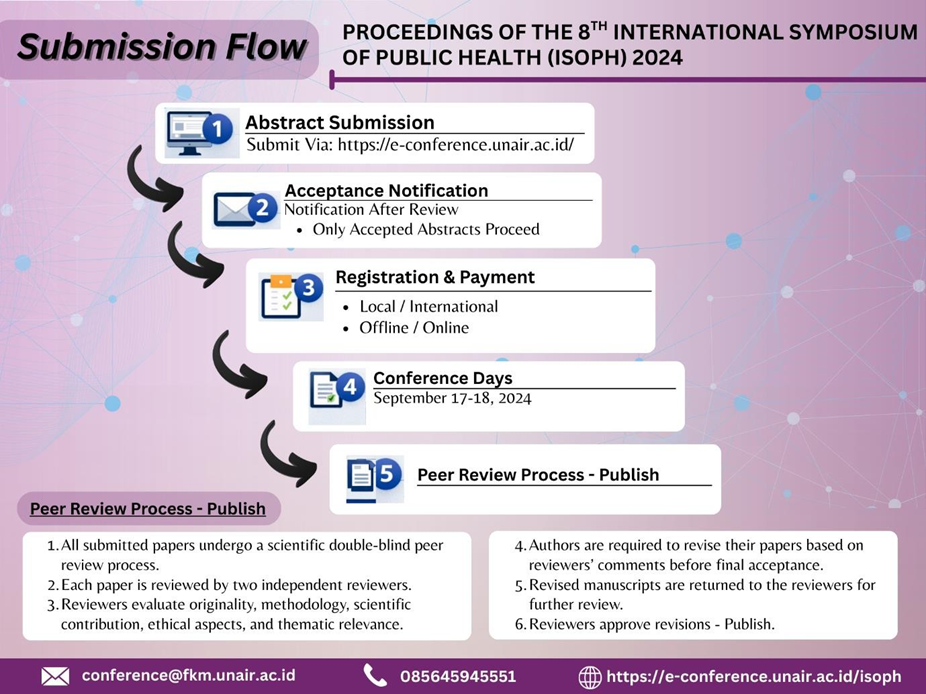
PEERREVIEWPROCESS
Allpaperssubmittedtotheproceedings“OpportunitiesandChallengesintheDevelopmentofAI-Based Public Health” undergo a scientific peer review process to ensure academic quality,thematic relevance, andscientificintegrityinthefield ofAI-based public health.
Each paper is reviewed by at least two reviewers with expertise relevant to the manuscripttopic,suchaspublichealth,epidemiology,healthinformationsystems,bioinformatics,health
datascience,andtheapplicationofAIinpublichealthservices.Reviewersassesstheoriginality,methodology,scientificcontribution,ethicalaspects,andrelevanceofthepapertothe themeof theproceedings.
The review process is conducted using a double-blind review method, in which the identitiesof both authors and reviewers are concealed to ensure objective and unbiased evaluation.Reviewersaregivenaspecifiedperiodtocompleteoneroundofreview,and theirassessmentsare used by theeditor or scientificcommitteeasthe basisfor decision-making.
Ifrevisionsarerequired,authorsmustrevisetheirmanuscriptsbysystematicallyaddressingallcommentsandrecommendationsprovidedbythereviewers.Theeditororscientificcommitteewill verifytherevised manuscript beforemakingafinaldecision on acceptance. The entire peer review and manuscript management process is conducted online through the proceedings management system or plaform designated by the organizer, while upholding the principles of transparency, confidentiality, and ethical standards of scholarly publication.
COPYRIGHT
- The copyright of papers published in the proceedings “Opportunities and ChallengesintheDevelopmentofAI-BasedPublicHealth”istransferredtoUniversitasAirlangga asthepublisher,withtheknowledgeandconsentoftheauthors.Nevertheless,themoralrights to the scholarly work remain with the authors as the owners of the ideas andintellectualcontributions.
- The formal legal provisions regarding access to and use of the papers, in both printedandelectronicforms,aresubjecttotheCreativeCommonsAttribution–NonCommercial–ShareAlike(CCBY-NC-SA)license.ThislicensegrantsUniversitasAirlanggatherighttostore,reproduce,transfermediaorformats,managethepapersindatabaseform,maintain,andpublishthepapers,whiledulyprovidingattributiontotheauthorsandensuring that theworksarenot used forcommercial purposes.
- All papers published in these proceedings are open access and may be used foreducational,research,andscientificdevelopmentpurposesinthefieldofPublicHealth,particularly those related to the application and challenges of Artificial Intelligence(AI)
- UniversitasAirlanggaasthepublisher,aswellastheproceedingsorganizingcommittee, shall not be held responsible for any copyright infringement arising fromthe use of the published materials by third parties outside the terms of the applicablelicense
- Authors are required to complete and submit a statement of manuscript originality andcopyrighttransferformaspart ofthe publicationrequirementsforthese proceedings.

- Mailing AddressFacultyof Public Health,UniversitasAirlangga, Campus Merr Mulyorejo, Surabaya- 60115, Indonesia
- Emailconference@fkm.unair.ac.id
- Phone+62 85645945551
The 7th International Symposium on Public Health (ISoPH)
The Faculty of Public Health at Universitas Airlangga hosted the 7th International Symposium of Public Health (ISoPH) on October 2–3, 2023, at the Swiss-Belinn Hotel in Surabaya. Themed “Strengthening the Health System by Encouraging Community Independence to Improve Public Health Status in Society 5.0,” the event focused on addressing public health challenges in the post-pandemic era.
Dr. Hari Basuki Notobroto, Head of the Doctoral Program in Public Health, emphasized the need to examine public health shortcomings exposed during the pandemic and align future efforts with the evolving Society 5.0 framework.
The symposium featured keynote speakers from Indonesia, Malaysia, Thailand, Brunei, and Australia, and welcomed participants from countries including Yemen and Gambia. Representatives from Indonesia’s Ministry of Human Development and Culture and the East Java Health Office also participated.
A key goal of the event was to foster international research collaboration, particularly among doctoral and master’s students. With 145 participants, the symposium served as a platform for academic networking and knowledge exchange, promoting ongoing development in public health education and research.
Dr. Notobroto expressed hope that the symposium would significantly contribute to advancing public health knowledge and practice.
Proceeding The 7th ISoPH

The 6th International Symposium on Public Health (ISoPH)
The 6th ISOPH held in 2022 focuses on "Preparedness for Future Pandemic And Post Pandemic Recovery". This event will be held on 25-26 October 2022.
Some important points related to ISOPH 2022:
Theme : "Preparedness for Future Pandemic And Post Pandemic Recovery"
Time : 25-26 October 2022
Objective : Discuss preparedness for future pandemics and post-pandemic recovery from a public health perspective.
Focus : Discuss health education, physical activity, and applied technology for health
Output :
Journal of Public Health in Africa (JPHIA)
Vol 14, S 2 (2023): 6th International Symposium of Public Health (ISoPH)
https://publichealthinafrica.org/index.php/jphia/issue/view/14
The 3rd International Symposium of Public Health (ISoPH)
The 3rd International Symposium of Public Health (3rd ISOPH), was held at Wyndham Hotel, Surabaya, East Java, Indonesia from 31st October-1st November 2018. More than three-hundred attendees from 5 countries gathered to discuss research and applications in public health roles. The papers contained in this Proceedings cover a wide range of topics including: nutrigenomics and public health: the paradigm shift to disease prevention, tobacco use and dependence, health financing and health insurance, the application of ICT in health care, emerging and re-emerging infectious diseases: threats to human health, maternal and child health, primary health care, mental health, nutrition-enhancing as strategic investment, occupational health, environment health, health politics and policy, non-communicable disease, communicable disease and tropical disease, emerging and re-emerging disease, health service management, community resilience and public health practice, disaster management. The members of 3rd ISoPH Review Committee reviewed 290 abstracts and selected 73 papers published in ISBN publication. Preparation of these proceedings would not be possible without the assistance of 3rd ISoPH scientific committee. Thank you to Prof. Dr. Mohammad Nasih, SE., Mt., Ak., CMA (Rector of Universitas Airlangga), Prof. Dr. Tri Martiana, dr., M.S. (Dean Faculty of Public Health), Dr. Nyoman Anita Damayanti, drg., MS. (Coordinator of Doctoral Programme in Public Health) and Purwaningsih, S.Kp., M.Kes (Chair of 3rd ISoPH Organizing Committee) for their guidance and encouragement.
The 2nd International Symposium of Public Health (ISoPH)
Theme : Achieving SDGs in South East Asia: Challenging and Tackling of Tropical Health Problems
Time : November 11 - 12, 2017
Output :
Proceeding The 2nd ISoPH