
Guidelines for Abstract Preparation
 PAPER PROCEEDING FORMAT
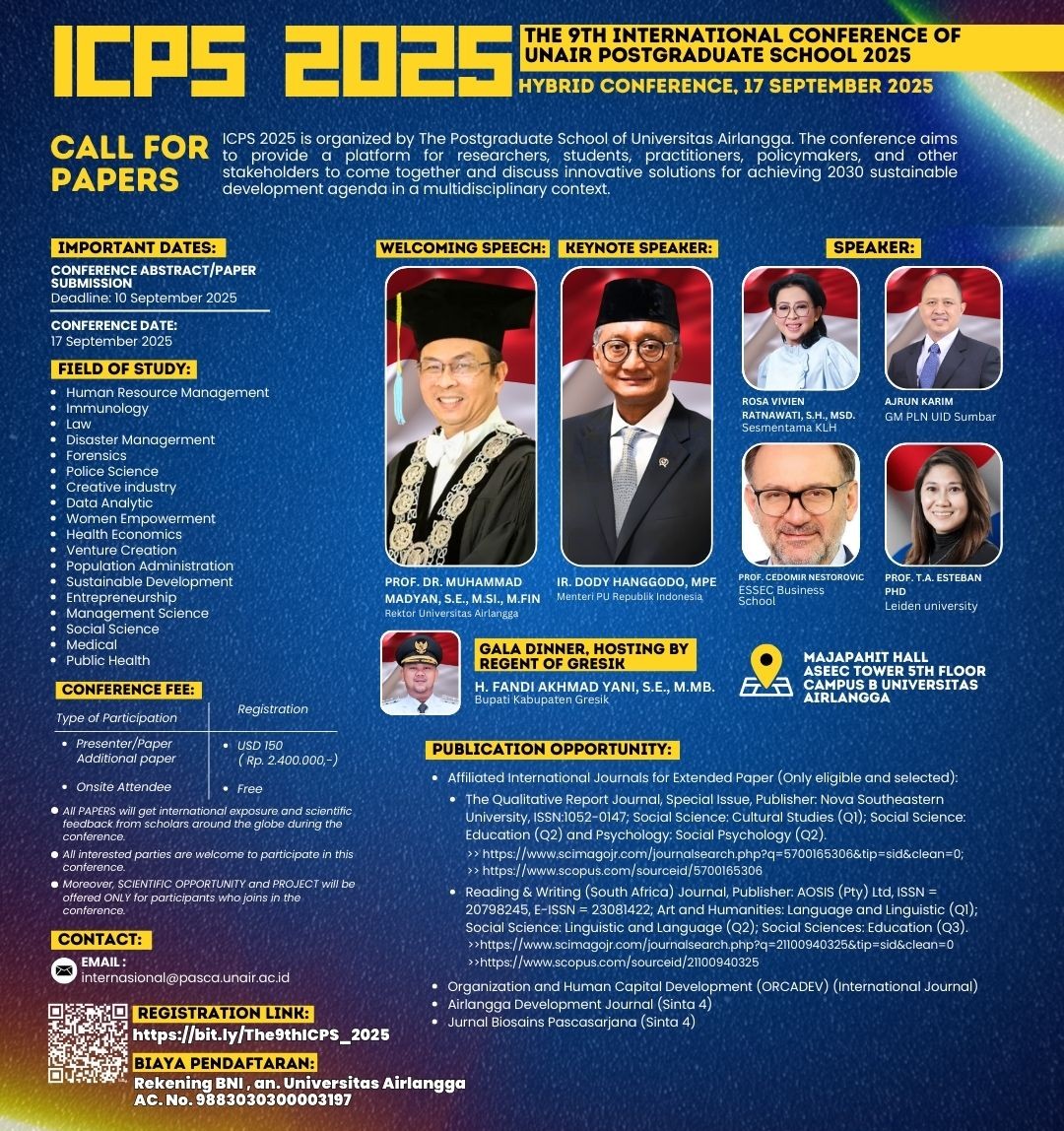
THE 9TH INTERNATIONAL CONFERENCE OF POSTGRADUATE SCHOOL UNIVERSITAS AIRLANGGA 2025
- The presenter can choose to upload Abstract only or Full Paper.
- The manuscript should be a maximum of 10,000 words, including embedded figures and tables, and the file should be in Microsoft Office (.doc/.docx) format.
- The paper should be prepared on A4 paper (21cm x 29.7cm) using 2.5 cm for the inside margin and 2 cm for the top, bottom, and outside margin. There is no need to alter the page number in this template, as the paper number will be reordered during the pre-printing process.
- The title, abstract, and main text should be in one column. The title should be less than 25 words, title case, small caps, centered, bold, font type Times New Roman (TNR), font size 16, and single-spaced.
- The main text of the writing should be in one column with 1 cm column spacing, justified, 12 TNR, first line indent 5 mm, and 1.5 spaced.
- The manuscript should begin with a title, abstract, and keywords, and the Full Paper should consist of: Introduction, Literature Review, Research Methodology, Findings and Discussion, Conclusion, and Further Research; followed by References.
Title (Capitalize First Letter)
Author1, Author2
1 Department, Affiliation, Country Xxxx, Xxxx
2 Department, Affiliation, Country Xxxx, Xxxx
1 E-mail address: xxx@xxx.xxx, 2 E-mail address: xxx@xxx.xxx
Abstract
The length of abstract is 250 words maximum. There are 4 main points to be addressed clearly in abstract section: (1) background of research table, (2) research purpose, (3) research methodology, and (4) research result/conclusion.
The background section should be the shortest part of the abstract and should very briefly outline the following information: What is already known about the subject, related to the paper in question? What is not known about the subject and hence what the study intended to examine (or what the paper seeks to present)?
Keywords: a, b, c, d, e
1. INTRODUCTION
State the objectives of the work and provide an adequate background, avoiding a detailed literature survey or a summary of the results. Explain how you addressed the problem and clearly state the aims of your study.
2. LITERATURE REVIEW
State the objectives of the work and provide an adequate background, avoiding a detailed literature survey or a summary of the results. A Theory section should extend, not repeat, the background to the article already dealt with in the Introduction, and lay the foundation for further work. A calculation section represents a practical development from a theoretical basis.
- RESEARCH METHODOLOGY
Methodology explains about what research method used, how the data collected and analyzed quantitatively or qualitatively to get new explanations in the result and discussion. - FINDING AND DISCUSSION
Results should be clear and concise. The results should summarize (scientific) findings rather than providing data in great detail. Please highlight differences between your results or findings and the previous publications by other researchers. For tables, they are generally numbered with the table title and number above the table. Tables should be cited in the column OR on the page.
3. CONCLUSION AND FURTHER RESEARCH
The study’s main conclusions may be presented as a short Conclusion section, which may stand alone or form a subsection in Discussion (or Results and Discussion). The conclusion should include the most important matter of the paper. Conclusions should answer the objectives of the research. Tell how your work advances the field from the present state of knowledge.
4. LIMITATION & FURTHER RESEARCH
The study’s limitation refers to factors beyond the researcher’s control that may have affected or influenced the interpretation of the findings from research. Further research should suggest the number of cases or locations for the results from your finding, or extend and further test this research.
REFERENCES
Barney J (1991) Firm resources and sustained competitive advantage. Journal of Management 17(1): 99–120. https://doi.org/10.1177/014920639101700108
Jones P, et al. (2017) Let’s get physical: Stories of entrepreneurial activity from sports coaches/instructors. The International Journal of Entrepreneurship and Innovation 18(4): 219–230. https://doi.org/10.1177/1465750317741878
Müller-Bloch C, Kranz J. (2015) A framework for rigorously identifying research gaps in qualitative literature reviews. In: Thirty Sixth International Conference on Information Systems, Fort Worth. Available at: core.ac.uk/download/pdf/301367526.pdf (accessed 24 June 2018).
Saunders, M., Lewis, P., & Thornhill, A. (2003). Research methods for business students. Essex: Prentice Hall: Financial Times.